

In the evolving landscape of decentralized finance, on-chain risk scores are quietly revolutionizing how lenders approach borrower trust. Traditional DeFi lending demands heavy over-collateralization, often 150% or more, tying up capital and stifling efficiency. Yet, as protocols mature, these scores draw from transparent blockchain data like repayment histories and wallet behaviors to enable progressive collateral reduction. This shift promises under-collateralized DeFi loans that reward reliability without blind faith, fostering a more dynamic lending ecosystem.

Consider the core appeal: a wallet's onchain repayment history becomes its resume. Protocols analyze transaction patterns, liquidity events, and interaction frequencies across chains. Veera FIS exemplifies this by normalizing EVM chain data into unified scores, empowering borrowers with proven track records to access loans with slimmer margins. No more one-size-fits-all over-collateralization; instead, scores dynamically adjust requirements, unlocking capital for high performers.
Decoding the Algorithms Behind On-Chain Risk Scores
At their heart, DeFi credit scoring systems like the On-Chain Credit Risk Score (OCCR Score) employ probabilistic models to quantify wallet risk. Drawing from arXiv research, these scores factor in variables such as loan-to-value ratios from past borrows, default frequencies, and even asset volatility exposures. Unlike opaque credit bureaus, everything unfolds on-chain, verifiable by anyone.
Think of it as a living ledger of financial hygiene. A borrower who consistently repays Dai from Maker vaults or navigates Aave positions without liquidations builds a robust profile. Machine learning layers normalize this data, outputting scores that protocols like Maple use for undercollateralized pools. Pool delegates, informed by these metrics, approve loans based on merit, not just asset pledges.
"DeFi Lending Platforms use credit reputation to lower collateral ratios for trustworthy borrowers. " - Duredev on Medium
This transparency mitigates the 'black box' pitfalls of traditional finance, but precision matters. Scores must weigh chain-specific nuances, like Ethereum's gas dynamics versus Solana's speed, to avoid skewed assessments.
Progressive Collateral Reduction in Action
Progressive collateral reduction takes this further, tiering requirements based on score evolution. Start with 200% collateral for a new wallet; as repayments accrue and behaviors stabilize, drop to 120%, then under 100%. This mirrors real-world credit lines, where good standing yields better terms.
In practice, imagine a trader with a strong OCCR Score locking ETH for a USDC loan on a protocol like Maker. Initial LTV caps at 60%, but on-chain proofs of timely interest payments trigger algorithmic reductions. Chainlink's onchain private lending highlights this for institutions, blending blockchain with credit assessment to issue under-collateralized facilities.
Yet, this isn't frictionless. Variable collateral assets demand higher initial deposits, as noted in Tim Roughgarden's DeFi survey; MKR holders calibrate risk parameters accordingly. Protocols counter with hybrid models, incorporating off-chain signals sparingly via oracles, though manipulation risks loom.
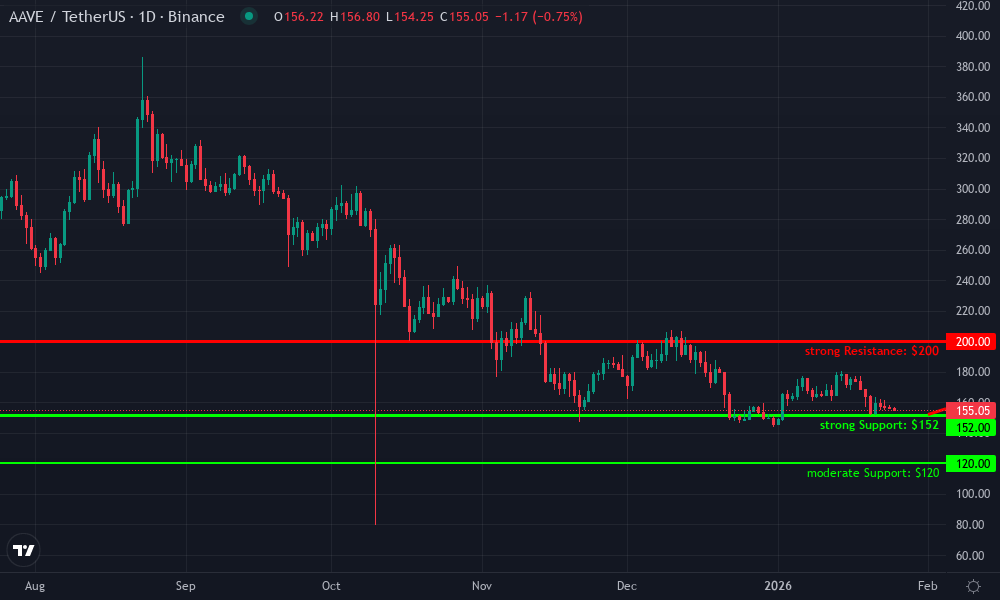
Aave Technical Analysis Chart
Analysis by Market Analyst | Symbol: BINANCE:AAVEUSDT | Interval: 1D | Drawings: 5
Technical Analysis Summary
To annotate this AAVEUSDT chart in my balanced technical style, start by drawing a primary downtrend line connecting the September 2026 high around 380 to the late January 2026 low near 150, extending it forward for potential continuation. Add horizontal support at 150 (recent lows) and resistance at 200 (prior swing high). Mark a consolidation rectangle from mid-December 2026 to early January 2027 between 200-250. Use fib retracement from the major Sep-Jan decline for pullback levels. Place long position marker near 150 support with stop below 140, profit targets at 200 and 250. Add callouts for volume spikes on breakdowns and text notes on bearish MACD divergence. Vertical line at late Dec 2026 for potential news catalyst aligned with DeFi credit score developments.
Risk Assessment: medium
Analysis: Bearish technicals dominate despite positive DeFi context; volatility high but support defined
Market Analyst's Recommendation: Wait for 150 hold for longs, prefer shorts on 200 rejection; scale in with medium position size
Key Support & Resistance Levels
📈 Support Levels:
- $152 - Strong recent lows with volume shelf, aligns with 0.618 fib strong
- $120 - Psychological and prior swing low extension moderate
📉 Resistance Levels:
- $200 - Recent breakdown level, prior consolidation high strong
- $250 - Mid-Dec range top, weaker on declining volume weak
Trading Zones (medium risk tolerance)
🎯 Entry Zones:
- $152 - Bounce from strong support in downtrend channel, medium risk long on volume confirmation medium risk
- $200 - Short entry on resistance retest with bearish candle low risk
🚪 Exit Zones:
- $200 - First profit target at resistance 💰 profit target
- $140 - Stop loss below support 🛡️ stop loss
- $120 - Trailing stop or deep target 💰 profit target
Technical Indicators Analysis
📊 Volume Analysis:
Pattern: increasing on breakdowns
Volume spikes confirm bearish moves, drying up on bounces indicating weakness
📈 MACD Analysis:
Signal: bearish crossover with divergence
MACD line below signal, histogram contracting negatively
Applied TradingView Drawing Utilities
This chart analysis utilizes the following professional drawing tools:
Disclaimer: This technical analysis by Market Analyst is for educational purposes only and should not be considered as financial advice. Trading involves risk, and you should always do your own research before making investment decisions. Past performance does not guarantee future results. The analysis reflects the author's personal methodology and risk tolerance (medium).
Navigating Risks and Real-World Hurdles
While promising, on-chain scores aren't panaceas. Critics, including Chainscore Labs, flag blind spots: off-chain liabilities evade detection, and oracle dependencies invite exploits. A market dip could cascade liquidations if scores overemphasize historical data over volatility spikes.
ScienceDirect's analysis of Maker underscores collateral's disciplinary role; loosening it via scores requires ironclad safeguards. Enter zero-knowledge proofs, enabling privacy-preserving verifiability. Borrowers prove creditworthiness without exposing full histories, balancing transparency with anonymity.
Veera FIS pushes boundaries here, scoring across chains to inform yields and loans. Early adopters report yield boosts, but scalability tests the model. As RWA waves hit $21B, platforms like Maple pivot to credit-assessed undercollateralization, signaling institutional buy-in.
This progressive model demands thoughtful calibration. Lenders must blend scores with stress tests, ensuring ruinous leverage stays at bay. Borrowers, meanwhile, gain incentives to cultivate impeccable on-chain personas, turning data trails into economic leverage.
Institutions entering the fray amplify this potential. Maple's pool delegates, armed with granular onchain repayment history, underwrite loans that sidestep excessive pledges, tapping into the $21B RWA surge for real-world yield. This isn't mere speculation; it's a recalibration of risk, where scores supplant collateral as the primary trust anchor.
Case Studies: Protocols Pioneering the Shift
Veera FIS stands out, aggregating behaviors across EVM chains into a normalized score that directly influences borrowing power. Users with consistent repayments see collateral thresholds erode progressively, boosting yields without added exposure. Similarly, emerging OCCR Score implementations, as detailed in arXiv papers, feed into lending dashboards, allowing protocols to simulate default probabilities before approving under-collateralized positions.
Maple Finance offers a compelling lens: delegates scrutinize wallet metrics, approving facilities where collateral dips below 100%. This model thrives on transparency; every repayment or default etches into the blockchain, refining future assessments. Mitosis University's explorations underscore how blending on- and off-chain data could further sharpen these tools, though purists insist on-chain purity to dodge oracle pitfalls.
Key Factors in On-Chain Risk Scores vs Traditional Collateral Requirements
| Metric | Impact on Score | Collateral Reduction Potential | DeFi Protocol Examples |
|---|---|---|---|
| Repayment History | Consistent on-chain repayments significantly boost score; defaults severely penalize | High (enables under-collateralized loans for top scores) | Veera FIS, OCCR Score protocols |
| Wallet Age & Activity | Older wallets with frequent positive interactions score higher, indicating reliability | Medium (progressive reduction from 150% to 120%) | MakerDAO, Mitosis University models |
| Asset Holdings & Diversification | Stable, diversified on-chain assets lower perceived risk | High (lower ratios for low-volatility collateral) | Maple (credit assessment), Aave adaptations |
| Cross-Chain Financial Behavior | Normalized activity across EVM chains improves score via comprehensive view | High (facilitates 100% or under-collateralized) | Veera FIS |
| Historical Borrow/Lend Interactions | Proven successful DeFi participation enhances trustworthiness | Medium-High (reduces from over-collateralized norms) | Maple, Onchain Private Lending |
These implementations reveal a truth: DeFi credit scoring isn't about eliminating risk but distributing it equitably. High-score wallets unlock efficiency gains, while laggards face steeper hurdles, mirroring merit-based finance without centralized gatekeepers.
Overcoming Implementation Barriers
Scalability poses the next frontier. Cross-chain data silos fragment scores, but bridges and layer-2 solutions are closing gaps. Zero-knowledge proofs, as Chainscore Labs advocates, let users attest to histories privately, curtailing surveillance concerns while upholding verifiability. Imagine proving a flawless repayment streak sans full disclosure; this unlocks institutional comfort for under-collateralized DeFi loans.
Regulatory shadows linger too. As onchain private lending matures, per Chainlink insights, clarity on borrower protections will dictate adoption. Protocols embedding ESG-aligned scoring, factoring sustainable asset interactions, could preempt scrutiny, aligning DeFi with broader financial mores.
Stress-testing remains non-negotiable. Simulations of black swan events, like those dissecting Maker's vaults in SSRN studies, ensure scores withstand volatility. Lenders blending probabilistic models with real-time oracles fortified by ZK create resilient frameworks, where progressive reduction feels earned, not reckless.
Unlocking Capital Efficiency Tomorrow
The payoff? Capital untethered. Over-collateralization idles billions; progressive collateral reduction recirculates them into productive loops. Borrowers scale positions fluidly, lenders harvest nuanced yields, and DeFi TVL swells organically. Aquanow's dives into unlocked lending paint this vividly: shift from blunt over-pledges to scored nuance multiplies opportunities.
Yet success hinges on user agency. Cultivating a stellar score demands discipline, timely repayments, diversified interactions, aversion to high-risk gambles. This gamifies responsibility, where on-chain footprints yield tangible privileges. As protocols iterate, expect hybrid scores incorporating DID for richer profiles, propelling under-collateralized norms.
Forward thinkers grasp this evolution's gravity. On-chain risk scores don't just tweak ratios; they redefine trust in code, paving for DeFi that rivals TradFi sophistication minus the suits. Lenders who pioneer thoughtfully, borrowers who build diligently, the ecosystem rewards both, one verified transaction at a time.




No comments yet. Be the first to share your thoughts!