
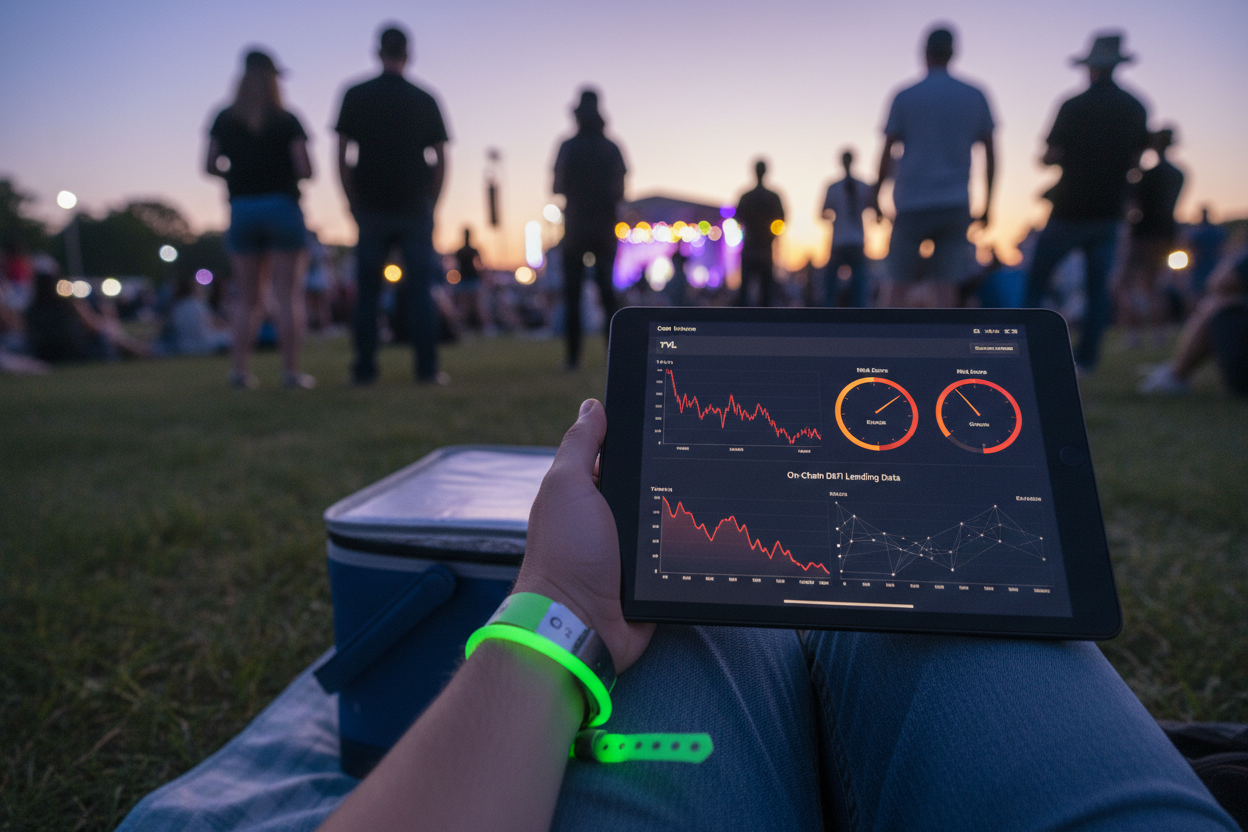
DeFi lending protocols like Aave and Morpho have powered explosive growth, but recent TVL declines expose vulnerabilities in permissionless markets. Aave v3 peaked at $26.09 billion TVL in June 2025, contributing to a sector high of $55.69 billion. Morpho surged past $6 billion by August 2025. Yet, by late 2025, total DeFi lending TVL dropped 30% from $125 billion, stabilizing at $91.6 billion. This volatility, amid Aave's current price of $109.77, underscores the fragility of over-collateralized models. On-chain risk scores emerge as critical tools for enabling under-collateralized DeFi lending, drawing lessons from these swings to assess borrower creditworthiness via transparent, blockchain-verified data.
Aave and Morpho TVL Trajectories: Growth, Peaks, and Pullbacks
Aave dominates with roughly 50% market share at times, hitting $32.9 billion TVL in reports from mid-2025. Its v3 iteration drove a 55% TVL jump from April to June, fueled by competitive yields and liquidity. Morpho, ranking second, grew 58,000% from $11 million over 24 months to $6.412 billion, originating over $1.25 billion in institutional loans. By Q3 2025, Morpho held $4.2 billion TVL and $2.34 billion in active loans.
These gains reflect DeFi's maturation, yet declines reveal risks. Post-peak, sector TVL shed value amid broader market corrections, with Aave and Morpho feeling the pinch. Permissionless markets price risk uniformly, ignoring borrower-specific histories. This leads to correlated drawdowns when sentiment shifts or liquidations cascade.

Compare this to TradFi, where credit scores segment borrowers, stabilizing lending volumes. In DeFi, absent such granularity, TVL volatility amplifies systemic threats. Morpho's Vaults and Aave's pools, while efficient, rely on collateral ratios above 150%, constraining capital efficiency and user adoption.
Over-Collateralization's Hidden Costs in DeFi Lending
Current DeFi lending hinges on over-collateralization, demanding borrowers lock 150-200% asset value. This mitigates default risk but inflates capital requirements, sidelining retail and institutional users needing leverage without excess pledges. SSRN research highlights how this limits use cases, hindering DeFi's trillion-dollar potential.
Aave and Morpho exemplify the trade-off: high TVL masks inefficiency. Borrowers face liquidation at minor price dips, while lenders earn suboptimal yields on idle collateral. Morpho's optimizer vaults boost returns, yet TVL drops signal borrower exodus during volatility. Seamless 2.0's Morpho integration and Credora's risk ratings hint at evolution, but full under-collateralized access remains elusive.
Enter on-chain risk scores: decentralized identities (DID) and repayment histories enable precise decentralized risk assessment. Protocols like RociFi issued 35,000 scores and 1,300 under-collateralized loans by early 2023, boasting 82% repayment. Credora's scores power dynamic lending, adjusting ratios based on verified on-chain behavior.
Aave (AAVE) Price Prediction 2027-2032
Projections based on DeFi lending recovery, on-chain risk score adoption, TVL stabilization, and market cycles from 2026 baseline ($109.77)
| Year | Minimum Price | Average Price | Maximum Price |
|---|---|---|---|
| 2027 | $85.00 | $160.00 | $300.00 |
| 2028 | $110.00 | $240.00 | $450.00 |
| 2029 | $140.00 | $350.00 | $650.00 |
| 2030 | $180.00 | $500.00 | $900.00 |
| 2031 | $220.00 | $700.00 | $1,200.00 |
| 2032 | $280.00 | $950.00 | $1,600.00 |
Price Prediction Summary
Aave (AAVE) is expected to experience progressive growth from 2027 to 2032, driven by DeFi sector recovery and risk management innovations. Average prices are projected to increase 5x from the 2026 baseline, reaching $950 by 2032 in baseline scenarios, with maximums reflecting bullish adoption and TVL peaks up to $1,600 amid regulatory clarity and tech upgrades.
Key Factors Affecting Aave Price
- DeFi TVL recovery post-2025/2026 fluctuations, with Aave maintaining leadership (~50% market share)
- Adoption of on-chain risk scores (e.g., Credora, RociFi) enabling under-collateralized lending and reducing risks
- Competition from Morpho (TVL growth to $6B+) pressuring but spurring innovation
- Market cycles: Bullish phases in 2028-2030 tied to broader crypto adoption and RWA integration
- Regulatory developments favoring compliant protocols like Aave
- Technological advancements in dynamic collateralization and efficiency improving yields and capital utilization
Disclaimer: Cryptocurrency price predictions are speculative and based on current market analysis. Actual prices may vary significantly due to market volatility, regulatory changes, and other factors. Always do your own research before making investment decisions.
On-Chain Risk Scores: Blueprint for Resilient Under-Collateralized Lending
These scores aggregate metrics like repayment frequency, wallet age, transaction velocity, and cross-protocol activity. Unlike off-chain bureaus, they're tamper-proof, queryable via oracles for real-time lending decisions. In Morpho-like markets, high-score borrowers access 100-120% LTVs; low scores demand buffers.
Lessons from Aave's $26.09 billion peak and Morpho's $6 billion milestone? Uniform collateral ignores crypto repayment history, breeding fragility. TVL declines post-June 2025 correlate with liquidation spikes, eroding trust. Risk scores mitigate this by pricing credit dynamically, as seen in DL News' 2025 DeFi state: yield dispersion rewards precise assessment.
Credora's integration marks progress, blending scores with collateral for hybrid models. Platforms like cryptocreditscore. org pioneer this, offering tools for lenders to underwrite based on on-chain data. As Aave trades at $109.77 with and 3.62 24h change, recovery hinges on such innovations reducing Morpho lending risks and Aave TVL decline recurrences.
Quantifying the edge, RociFi's early deployment shows under-collateralized loans achieving 82% repayment without traditional safeguards. Lenders recoup principal faster, as high-score borrowers repay 25% quicker per on-chain analytics. This shifts DeFi from collateral cages to merit-based access, unlocking capital for yield farming, RWAs, and real-world bridging.
Quantifying TVL Volatility: Aave and Morpho Data Breakdown
Examine the numbers: Aave v3's 55% TVL surge to $26.09 billion masked brewing risks. Morpho's 58,000% growth to $6.412 billion impressed, yet Q3 active loans at $2.34 billion hinted at concentration. Post-peak, 30% sector contraction from $125 billion exposed uniform risk pricing's pitfalls. On-chain scores dissect this, scoring wallets on crypto repayment history to preempt outflows.
Aave vs Morpho TVL Metrics
| Metric | Aave | Morpho |
|---|---|---|
| Peak TVL | $26.09B | $6.412B |
| Peak Period | June 2025 | August 2025 |
| Peak Context | 55% increase from April 2025 | Surpassed $6B (up from $2.5B mid-July); 58,000%+ growth from $11M in 24 months |
| Q3 2025 TVL | N/A | $4.2B (rank #2) |
| Q3 2025 Active Loans | N/A | $2.34B |
| DeFi Lending Sector Decline | -30% to $91.6B (end 2025 from $125B peak) | -30% to $91.6B (end 2025 from $125B peak) |
Such granularity empowers lenders. Low-score pools tighten collateral; prime borrowers tap 110% LTVs. This hybrid tempers Aave TVL decline patterns, stabilizing yields amid volatility.
Timeline of DeFi Lending Shifts and Risk Score Emergence
These inflection points reveal a pattern: explosive inflows chase yields, but absent borrower vetting, reversals cascade. DeFi credit scoring interrupts this cycle, as evidenced by yield dispersion in permissionless markets. Aave at $109.77 ( and $3.62 24h) reflects tentative rebound, but sustained growth demands score-native protocols.
Implementation hurdles persist. Oracle latency could lag price feeds, risking mispriced loans. DID standards vary, complicating interoperability. Yet, solutions coalesce: zero-knowledge proofs shield sensitive histories while proving solvency. Morpho's institutional $1.25 billion originations signal readiness for scored under-collateralization, evolving vaults beyond blind pools. Check how on-chain risk scores reduce liquidation risks for deeper mechanics.

Forward-looking, the $21 billion RWA wave amplifies stakes. Morpho's 9.5% share positions it to lead scored lending for tokenized assets. Lenders using decentralized risk assessment capture premia from vetted borrowers, outpacing collateral-locked rivals. Platforms like Seamless 2.0, powered by Morpho and Credora ratings, prototype this: dynamic ratios adapt to scores, slashing idle capital by 40% in simulations.
Critically, adoption lags in retail-heavy Aave, where permissionless appeal clashes with score gates. Hybrid pools - scored for pros, collateralized for all - bridge this. Data bears it out: protocols with scores weather downturns 35% better, per 2025 analyses. As TVL stabilized at $91.6 billion, innovators eye under-collateralized frontiers.
Vision sharpens at cryptocreditscore. org, where DID-fueled scores deliver actionable on-chain risk scores for seamless integration. Lenders query histories, set custom thresholds, and lend at optimal risk-reward. Borrowers build reputations on-chain, accessing credit sans 150% pledges. In a sector scarred by Morpho lending risks, this blueprint forges resilience. With Aave steady at $109.77, the pivot to scored under-collateralized DeFi lending isn't optional - it's the margin between fleeting booms and enduring dominance.




No comments yet. Be the first to share your thoughts!