

Picture this: you’re deep in DeFi, eyeing a sweet loan to leverage your next trade, but bam, protocols demand 150% or more collateral just to borrow stablecoins. It’s like showing up to a poker game with your house deed on the table before anyone deals the cards. That’s the reality of today’s DeFi lending, but on-chain risk scores are flipping the script, paving the way for under-collateralized DeFi loans and even zero collateral lending crypto. With crypto lending hitting a whopping $73.6 billion record, as per Galaxy Research via Yahoo Finance, it’s clear the market’s hungry for efficiency.

Ethereum Technical Analysis Chart
Analysis by Jared Hollister | Symbol: BINANCE:ETHUSDT | Interval: 4h | Drawings: 7
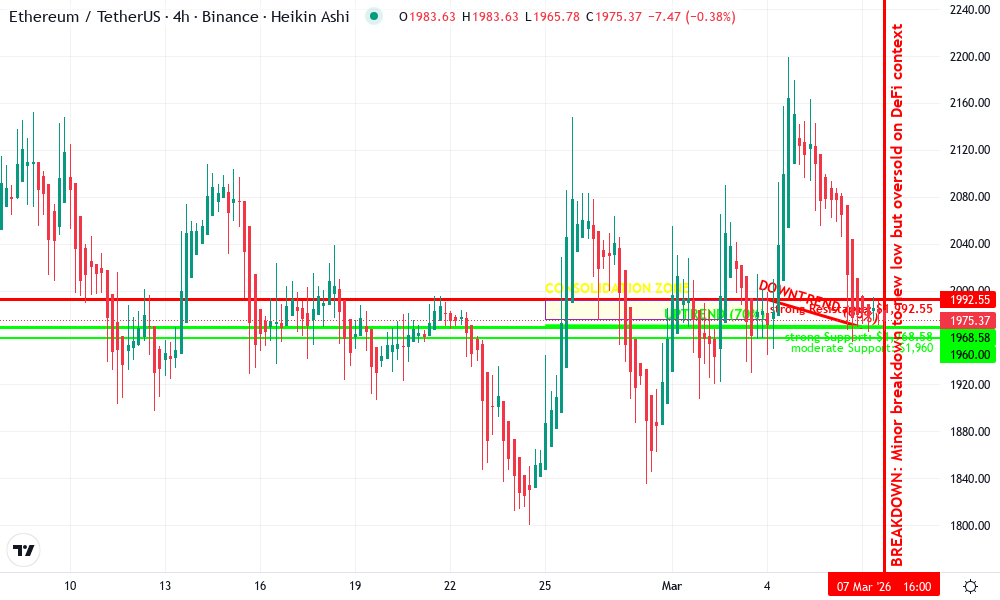
Technical Analysis Summary
Aggressively mark the descending channel with a thick red downtrend line from the March 4 peak at $1,992.55 connecting to today’s low at $1,968.58, extending forward for potential retest. Overlay horizontal lines at key S/R: green support at $1,968.58 (daily low), orange resistance at $1,992.55 (24h high). Add long position rectangle from $1,969 entry zone up to $1,992 PT, with stop below $1,965. Fib retracement 0.618 from recent swing high-low. Callout volume spike on downside with ‘divergence?’ text. MACD bear cross arrow down, but watch for reversal. Vertical line on Mar 7 for ‘DeFi credit news pump setup’. Rectangle consolidation Feb 25-Mar 4. Arrows up for bounce potential. Style: bold lines, aggressive colors – red for bears, green for my long bias.
Risk Assessment: high
Analysis: Crypto volatility + fresh DeFi credit narratives = explosive moves, but tight stops essential
Jared Hollister’s Recommendation: Aggressive long entry now – high risk tolerance pays in swings like this!
Key Support & Resistance Levels
📈 Support Levels:
-
$1,968.58 – 24h low – strong intraday support with volume cluster
strong -
$1,960 – Psychological round + prior swing low
moderate
📉 Resistance Levels:
-
$1,992.55 – 24h high – immediate overhead resistance
strong -
$2,000 – Recent consolidation top
weak
Trading Zones (high risk tolerance)
🎯 Entry Zones:
-
$1,969.21 – Bounce from daily low amid low volume downside + DeFi narrative support
high risk
🚪 Exit Zones:
-
$1,992.55 – Break 24h high for DeFi pump continuation
💰 profit target -
$1,965 – Below support invalidates long
🛡️ stop loss
Technical Indicators Analysis
📊 Volume Analysis:
Pattern: decreasing on downside (bullish divergence)
Volume fading on pullback suggests exhaustion, prime for reversal
📈 MACD Analysis:
Signal: bearish crossover but momentum waning
MACD histogram contracting – watch for bullish flip on DeFi news
Applied TradingView Drawing Utilities
This chart analysis utilizes the following professional drawing tools:
Disclaimer: This technical analysis by Jared Hollister is for educational purposes only and should not be considered as financial advice.
Trading involves risk, and you should always do your own research before making investment decisions.
Past performance does not guarantee future results. The analysis reflects the author’s personal methodology and risk tolerance (high).
Enter DeFi credit scoring via on-chain data. Instead of blind overcollateralization, protocols analyze your onchain repayment history, wallet interactions, and even cross-chain behavior. Sources like the Onchain Foundation predict this unlocks trillions for DeFi, ditching the 150% collateral crutch for smarter, reputation-based crypto credit.
Decoding On-Chain Risk Scores and ZK Magic
At its core, on-chain risk scores are like FICO scores on steroids, built from immutable blockchain footprints. Your history of repaying loans, avoiding defaults, and smart contract savvy gets quantified into a score. The killer twist? Zero-knowledge proofs (ZKPs). They prove you’re creditworthy, say, a 750 and score, without doxxing your wallet. Chainscore Labs nails it: this combo is the killer app for ZKPs, enabling undercollateralized lending while keeping privacy intact.
Think about it practically: a trader with flawless onchain repayment history borrows at 100% collateral or less, rates drop because risk’s quantified. No more one-size-fits-all 150-200% ratios. Bankless calls this the next frontier of onchain lending, evolving DeFi into programmable money minus the bloat.
Ethereum (ETH) Price Prediction 2027-2032
Forecasts driven by on-chain credit scoring adoption enabling undercollateralized and zero-collateral DeFi loans, boosting DeFi TVL and ETH utility
| Year | Minimum Price | Average Price | Maximum Price | YoY % Change (Avg from 2026 $1,970) |
|---|---|---|---|---|
| 2027 | $1,800 | $2,500 | $3,800 | +26.9% |
| 2028 | $2,500 | $4,200 | $6,500 | +68.0% |
| 2029 | $4,000 | $7,000 | $11,000 | +66.7% |
| 2030 | $5,500 | $8,500 | $13,000 | +21.4% |
| 2031 | $7,000 | $11,000 | $17,000 | +29.4% |
| 2032 | $9,000 | $14,000 | $22,000 | +27.3% |
Price Prediction Summary
Ethereum (ETH) is forecasted to experience substantial growth from 2027-2032, with average prices rising from $2,500 to $14,000, fueled by DeFi innovations like on-chain credit scores reducing collateral requirements, protocols such as Aave and Compound integrating risk assessments, and projected DeFi TVL expansion to trillions. Bullish maxima reflect adoption and market cycles, while minima account for potential corrections and regulatory hurdles.
Key Factors Affecting Ethereum Price
- Widespread adoption of on-chain credit scoring and ZKPs for privacy-preserving risk assessment
- Integration into major protocols (Aave, Compound) enabling undercollateralized loans beyond 150% overcollateralization
- DeFi TVL surge from current $73.6B record, unlocking trillions in capital efficiency
- Ethereum’s scalability upgrades (e.g., L2s) supporting higher transaction volumes
- Market cycles aligned with Bitcoin halvings and institutional inflows
- Regulatory developments favoring compliant DeFi and RWAs
- Competition from other L1s but ETH dominance in DeFi lending
- Current 2026 price baseline of $1,969 amid slight downturn, setting stage for recovery
Disclaimer: Cryptocurrency price predictions are speculative and based on current market analysis.
Actual prices may vary significantly due to market volatility, regulatory changes, and other factors.
Always do your own research before making investment decisions.
Protocols Putting On-Chain Scores into Action
Aave’s Health Factor is the OG example, your real-time solvency score based on collateral vs. debt. Above 1.0? You’re golden. Dip below? Liquidation looms. But now, layer on-chain credit data, and Health Factors get turbocharged with reputation metrics. Compound’s iterating too, blending governance tokens like COMP with risk models. These aren’t hypotheticals; integrations are live, slashing collateral needs for proven borrowers.
Chainlink’s DECO pushes boundaries further, securing off-chain data for on-chain use, fueling undercollateralized DeFi lending. Mitosis University breaks it down: on-chain scores and undercollateralized loans = decentralized credit revolution. Imagine yields spiking as lenders deploy capital smarter, not safer via excess collateral.
Challenges persist, anonymity means oracle reliance for off-chain signals, and RWAs add custody headaches. Yet, as CoinGecko asks, what about users sans collateral? On-chain risk scores answer, fostering inclusion without recklessness. Check this deep dive for more on the mechanics.
Real-world traction is building fast. Take Ledn’s rundown of top DeFi loan platforms in 2026: undercollateralized options are emerging, leaning on alternative risk tools like on-chain risk scores. CoW DAO highlights how DeFi lending mechanics pair with swaps to shield strategies, amplifying the power of reputation-based systems.
Unlocking Capital Efficiency in Today’s Market
Right now, with Ethereum holding steady at $1,969.21, down just 0.29% over the last 24 hours, DeFi’s pulse is strong. Aave’s AAVE sits at $109.38, Compound’s COMP at $17.38, and Maker’s MKR climbing to $1,712.15. These prices underscore a maturing ecosystem where smart risk assessment can prevent liquidations during dips like ETH’s intraday low of $1,968.58.
Current Prices, 24h Changes, and Liquidation Risk Indicators for 150% Collateral Positions
| Asset | Price (USD) | 24h Change | Liquidation Risk (150% Collateral) |
|---|---|---|---|
| ETH | $1,969.21 | -0.29% | 🟢 Low |
| AAVE | $109.38 | -1.09% | 🟢 Low |
| COMP | $17.38 | -0.17% | 🟢 Low |
| MKR | $1,712.15 | +0.89% | 🟢 Low |
Lenders love this shift. Capital that once sat idle in overcollateralized vaults now circulates freely, boosting yields. Borrowers with solid onchain repayment history snag better terms, turning DeFi into a true alternative to TradFi. Isaac Tham’s Medium deep dive spells it out: undercollateralized lending delivers superior yields through refined risk models.
Key Benefits of On-Chain Risk Scores
-

Higher Capital Efficiency: Free up locked assets beyond 150% overcollateralization—put your capital to work instead of idling in vaults like on Aave!
-

Lower Borrowing Costs: Ditch excessive collateral requirements to slash fees and interest rates for borrowers in protocols evolving like Compound.
-
Financial Inclusion: Uncollateralized users get access—bridge the gap for those without upfront assets, as highlighted by Onchain Foundation.
-

Privacy via ZKPs: Prove creditworthiness without exposing data, thanks to zero-knowledge proofs powering secure lending.
-
Reduced Liquidation Risks: Dynamic scores like Aave’s Health Factor predict and prevent blowups, keeping loans safer.
Getting started is straightforward. Connect your wallet to a protocol like Aave, let it scan your on-chain behavior for a DeFi credit scoring snapshot. High score? Borrow with minimal collateral. Low? Build reputation through small, timely repayments. It’s merit-based lending at warp speed.
Navigating Risks and Building Trust
Sure, hurdles like oracle accuracy and cross-chain data silos loom large. LARC at Cardozo points to crypto-native scores bridging inclusion gaps, but robust auditing is non-negotiable. Protocols counter with slashing mechanisms and insurance funds, ensuring lenders sleep easy even in zero collateral lending crypto scenarios.
Flash forward: as adoption surges, expect hybrid models blending RWAs with pure on-chain reps. Galaxy Research’s $73.59 billion crypto lending peak signals the runway. Traders, stack that reputation-based crypto credit now; it’s your ticket to leverage without the collateral drag. Dive deeper at our 2025-2026 guide or explore credit score transformations.
The edge goes to those ahead of the curve. With on-chain scores live and scaling, DeFi sheds its training wheels, racing toward a trillion-dollar playground where risk is priced right, not padded with excess assets. Your move.
About the Author