

In the evolving world of DeFi, undercollateralized lending promises to unlock capital efficiency long stifled by the rigidity of over-collateralization. Traditional protocols demand borrowers lock up assets worth 150% or more of the loan value, a safeguard that works but at the cost of excluding creditworthy users without spare crypto holdings. Enter on-chain risk scores: verifiable, tamper-proof metrics drawn from a user’s blockchain history. These scores pit reputation against collateral, offering lenders a fresh lens on risk while expanding access to reputation based crypto loans. But does this shift truly mitigate defaults, or does it introduce new vulnerabilities?

Over-collateralization has been DeFi’s bedrock since Aave and Compound set the standard. Lenders sleep easy knowing they can liquidate collateral if borrowers falter. Yet this model ties up billions in idle assets, especially when crypto prices swing wildly. A borrower eyeing a $10,000 loan might need to post $15,000 in ETH, only for market dips to trigger premature liquidations. Capital inefficiency aside, it sidelines real-world businesses and individuals whose value lies in off-chain cash flows or proven track records, not volatile tokens.
The Promise and Pitfalls of Reputation-Based Scoring
On-chain risk scores flip the script by quantifying reputation through transparent data: repayment histories, governance votes, liquidity provision, and even social attestations via Ethereum Attestation Service (EAS). Protocols like EigenLayer layer these signals into dynamic profiles, where a high score signals low default risk. Think of it as a crypto FICO score, but immutable and public. This enables DeFi credit scoring that rewards long-term good behavior, potentially slashing collateral needs to 0% for top-tier users.
Yet reputation isn’t foolproof. Sybil attacks loom large; bad actors could farm scores with multiple wallets. And on-chain history favors early adopters, potentially baking in inequality. Recent discussions highlight how protocols blend on- and off-chain data to counter this. Goldfinch, for instance, uses soulbound tokens (SBTs) and KYC for its decentralized groups, while TrueFi and Maple lean on permissioned pools with dedicated delegates underwriting risks. These hybrids show undercollateralized lending in DeFi isn’t purely on-chain fantasy; it’s pragmatic evolution.
Pioneering Undercollateralized DeFi Protocols
-

Goldfinch: Leverages Soulbound Tokens (SBTs) and decentralized borrower groups for reputation-based lending to emerging markets.
-

Maple: Features permissioned pools with KYC’d borrowers and pool delegates handling off-chain underwriting.
-

TrueFi: Employs KYC delegates and governance for undercollateralized credit without traditional collateral.
-

Clearpool: Relies on off-chain legal agreements and permissioned pools for institutional-grade lending.
Dissecting Goldfinch and Maple: Real-World Risks Exposed
Goldfinch stands out as the veteran in Goldfinch lending risks, targeting emerging markets with loans to non-crypto natives like PayJoy. Its model relies on backers rating borrowers, backed by off-chain evaluations. Success stories abound, but defaults have tested resilience; junior tranches absorbed losses without systemic fallout. Maple Finance, meanwhile, pitches institutional-grade Maple finance undercollateralized lending, emerging post-FTX to exploit centralized lenders’ opacity. Pool delegates perform due diligence, yet Reddit threads question sustainability amid borrower KYC requirements and off-chain logic.
“A high Ethos score allows users to access undercollateralized loans because the social cost of defaulting, destroying one’s on-chain reputation, is too high. “
These protocols reveal a core tension: reputation scores excel at signaling intent but falter without enforcement. On-chain data provides verifiability, yet lacks nuance for off-chain borrower quality. Clearpool and TrueFi mitigate via legal agreements, but decentralization purists argue this reintroduces trusted parties. As DeFi matures post-2025 crash, the bet is on advanced layers like EAS to forge truly collateral-free paths. Lenders must weigh if a stained reputation deters defaults more effectively than liquidation bots.
Early data suggests promise. Goldfinch’s TVL hovers steadily, with low senior tranche losses. Maple’s institutional inflows signal trust in delegate models. Still, challenges persist: accurately weighting on-chain signals, resisting gaming, and scaling to mass adoption. For more on mechanics, check how on-chain risk scores enable under-collateralized lending in DeFi.
Building Robust On-Chain Risk Engines
Crafting reliable DeFi credit scoring demands multi-factor models. Repayment velocity, wallet age, interaction diversity, and attestation counts form the backbone. EigenLayer’s restaking ties economic security to reputation, where slashing misbehavers mirrors collateral liquidation. This hybrid, reputation as soft collateral, could redefine risk. But calibration is key; over-reliance on history ignores black swan events, like the 2025 crash that humbled even pristine profiles.
Protocols are iterating on composite scores, blending factors like repayment velocity with interaction diversity to resist manipulation. On-chain oracles, potentially powered by machine learning via zero-knowledge proofs, could dynamically adjust these metrics without compromising decentralization. EigenLayer’s restaking paradigm exemplifies this: users stake on reputation integrity, facing slashes akin to liquidations but rooted in behavioral data rather than asset dumps.
Reputation vs Collateral: Quantifying the Risks
To grasp the stakes in undercollateralized lending DeFi, consider the trade-offs head-on. Collateral enforces hard limits through automated liquidations, minimizing lender exposure but amplifying volatility risks. Reputation, conversely, leverages social and economic deterrence; a default nukes future borrowing power across ecosystems. Yet it demands sophisticated scoring to avoid false positives or gaming.
Collateralized vs. Reputation-Based DeFi Lending: Key Comparisons
| Aspect | Collateralized (Aave/Compound) | Reputation-Based (Goldfinch/Maple) |
|---|---|---|
| Risk Mitigation | Over-collateralization (150-200%+), automated liquidations 🔒 | On-chain reputation scores (e.g., Ethos), off-chain KYC/SBTs, pool delegates/underwriting 👤 |
| Capital Efficiency | Low: Collateral exceeds loan value, high idle capital 📉 | High: Undercollateralized (near 100%), better yields 📈 |
| Default Rates | Very low: Liquidations prevent most losses 📉 | Moderate/higher: Mitigated by reputation but elevated vs. collateralized ⚠️ |
| Pros/Cons | ✅ Proven security, trustless, fully on-chain ❌ Capital inefficient ❌ Excludes undercollateralized borrowers |
✅ Capital efficient, financial inclusion 🌍 ✅ Higher yields for lenders ⚠️ Higher default risk ⚠️ Relies on off-chain factors/legal agreements |
Real-world metrics underscore the tension. Goldfinch’s senior tranches boast sub-1% loss rates, shielding lenders while junior backers chase yields. Maple’s pools, underwritten by delegates, have navigated borrower stress post-2025 crash with measured defaults, thanks to off-chain diligence. TrueFi mirrors this, blending KYC with on-chain transparency. Still, Reddit skeptics point to scalability hurdles: without robust on-chain risk scores, permissioned models risk centralization creep.
Visualizing protocol resilience reveals patterns. Goldfinch TVL stabilized amid market turmoil, hinting reputation buffers outperform pure collateral in prolonged downturns.
Ethereum Technical Analysis Chart
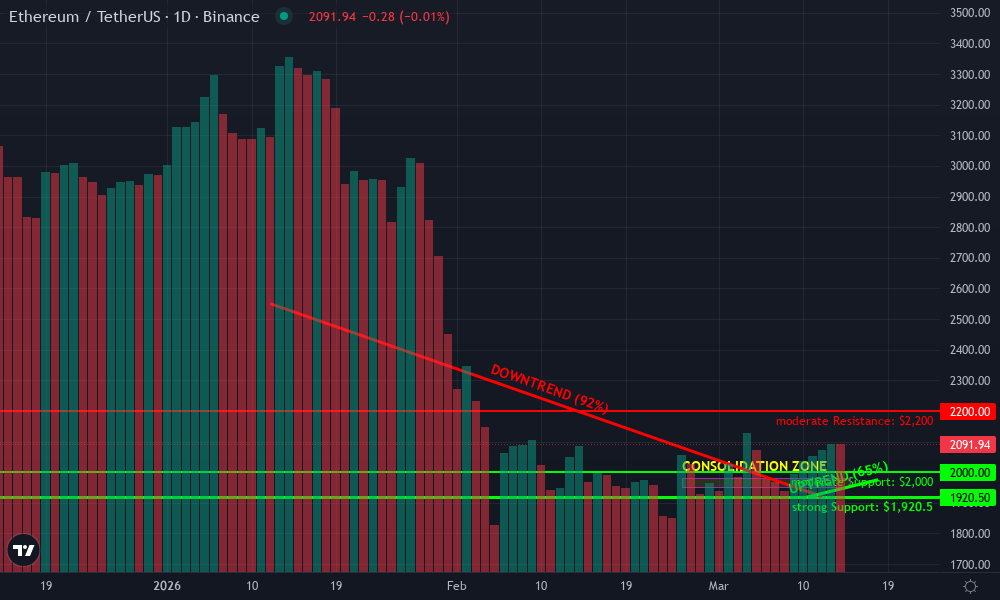
Analysis by Devon Carlisle | Symbol: BINANCE:ETHUSDT | Interval: 1D | Drawings: 6
Technical Analysis Summary
To annotate this ETHUSDT chart in my hybrid style: Start with a bold red downtrend line connecting the January high at ~2550 (2026-01-12) to the March low at ~1920 (2026-03-12), highlighting the dominant bearish channel. Add horizontal support at 1900-1920 (strong, green line) and resistance at 2100 (moderate, red dashed). Mark a recent consolidation rectangle from late Feb to mid-Mar between 1920-1980. Place arrow_mark_down at MACD bearish divergence around early Feb. Use callout on volume for ‘declining volume on pullback’ near March. Add fib_retracement from Jan high to Mar low for potential bounce levels at 38.2% (~2100). Entry long zone at 1920 with stop below 1880, target 2100. Overall, balanced view: technical bearish but DeFi reputation lending news could spark reversal.
Risk Assessment: medium
Analysis: Bearish technicals countered by DeFi fundamental tailwinds; medium tolerance fits waiting for confirmation
Devon Carlisle’s Recommendation: Hold cash or scale in long at support; avoid shorts in hybrid context
Key Support & Resistance Levels
📈 Support Levels:
-
$1,920.5 – Strong March low with volume spike, key psychological floor
strong -
$2,000 – Moderate prior swing low from late Feb
moderate
📉 Resistance Levels:
-
$2,100 – Weak recent high, aligns with 38.2% fib retrace
weak -
$2,200 – Moderate channel midline resistance
moderate
Trading Zones (medium risk tolerance)
🎯 Entry Zones:
-
$1,925 – Bounce from strong support with MACD flattening, hybrid DeFi catalyst potential
medium risk
🚪 Exit Zones:
-
$2,100 – Profit target at resistance/fib level
💰 profit target -
$1,880 – Stop loss below March low to protect capital
🛡️ stop loss
Technical Indicators Analysis
📊 Volume Analysis:
Pattern: declining on downside, increasing on pullback
Bearish volume divergence suggests weakening sellers
📈 MACD Analysis:
Signal: bearish but histogram contracting
MACD line below signal with potential bullish divergence
Applied TradingView Drawing Utilities
This chart analysis utilizes the following professional drawing tools:
Disclaimer: This technical analysis by Devon Carlisle is for educational purposes only and should not be considered as financial advice.
Trading involves risk, and you should always do your own research before making investment decisions.
Past performance does not guarantee future results. The analysis reflects the author’s personal methodology and risk tolerance (medium).
Delegates and groups add human judgment missing in pure on-chain setups, yet purists crave full automation. Equilibrium’s analysis flags early undercollateralized efforts as off-chain heavy, but 2026 brings momentum via EAS attestations. Users build profiles through governance and liquidity, earning access to reputation based crypto loans with minimal skin-in-the-game.
Undercollateralized lending remains niche, but protocols blending data sources are inching toward mainstream viability.

This hybrid path tempers idealism with pragmatism. Lenders gain yield premiums without courting catastrophe, borrowers tap credit matching real merit. Challenges linger, though: Sybil resistance via DID integration, equitable scoring for new wallets, and oracle reliability against flash loan exploits. Post-crash scrutiny sharpened focus; no longer speculative, DeFi credit scoring eyes utility.
Goldfinch’s emerging market wins and Maple’s institutional pull prove viability, yet sustainability hinges on on-chain purity. As Ethos-like scores mature, the social cost of default could eclipse collateral’s blunt force. Lenders eyeing Goldfinch lending risks or Maple finance undercollateralized plays should prioritize protocols with audited multi-sig delegates and transparent loss waterfalls.
Forward, expect deeper EigenLayer-EAS fusion, where attestations weight scores and restaking enforces. Platforms like cryptocreditscore. org pioneer these tools, arming users with actionable insights. For deeper dives, explore how onchain risk scores enable under-collateralized crypto loans or how on-chain risk scores enable under-collateralized lending in DeFi 2025 guide. The era of reputation as collateral beckons, promising DeFi that mirrors traditional finance’s nuance without its opacity.
About the Author