

Crypto credit score 2026 limits to account for
In 2026, the crypto credit score is not a single number but a dynamic risk assessment derived from on-chain behavior. Traditional credit bureaus do not report DeFi activity, so lenders rely on alternative data sources to evaluate counterparty risk. These scores measure how reliably you manage collateralized positions, repay loans, and interact with smart contracts.
The primary constraint is data opacity. Unlike a traditional FICO score built from credit card payments and loan history, your crypto score is built from transaction histories that can be anonymous or fragmented across multiple wallets. Institutions like Gio Ratings and Fitch Ratings now provide specialized counterparty risk scores for exchanges and custodians, but individual borrower scores remain less standardized.
Lenders assess your score by analyzing your collateralization ratio and repayment consistency. If you consistently maintain a high collateralization ratio (e.g., 150%+) and repay loans early, your risk profile improves. Conversely, frequent liquidations or interactions with high-risk protocols lower your score. This creates a feedback loop: a higher score grants access to lower interest rates and larger borrowing limits, while a lower score restricts access to capital.
The 2026 landscape emphasizes transparency. New protocols are integrating verifiable credentials to bridge on-chain activity with off-chain credit systems. However, the lack of a universal standard means your score may vary depending on the lender. It is essential to understand which data points each platform uses to calculate your score, as this directly impacts your borrowing power.
Crypto credit score 2026 choices that change the plan
Evaluating your crypto credit score in 2026 requires looking past the headline rating to understand the mechanics behind it. Unlike traditional FICO scores, which rely on a decade of bank statements and utility bills, a crypto-native credit score is built entirely from on-chain data. This shift means your "creditworthiness" is now a reflection of your digital footprint rather than your banking history.
The primary tradeoff lies in volatility versus accessibility. Traditional credit models penalize income instability, but crypto lending platforms often ignore your off-chain income entirely. Instead, they focus on the stability of your collateral. This makes DeFi lending more inclusive for those with thin or non-existent credit files, but it introduces a new risk: liquidation. If your collateral drops in value, your credit score can plummet instantly, regardless of your repayment history.
To navigate this landscape, you must evaluate three concrete factors: collateral type, loan-to-value (LTV) ratios, and repayment consistency. The following comparison table breaks down how different collateral assets impact your score trajectory in the current market.
Stablecoin collateral offers the steadiest path to building a score. Because the asset value does not fluctuate significantly, your loan-to-value ratio remains stable, allowing for consistent, low-risk borrowing. This is ideal for users who want to demonstrate repayment reliability without risking their principal. However, stablecoins often yield lower returns, meaning you might miss out on the upside potential of holding other assets.
Bitcoin collateral strikes a balance. It is widely recognized by rating agencies like Fitch and Gio Ratings as a "hard asset," which lends credibility to your credit profile. However, its 20-30% annual volatility means you must maintain a lower LTV ratio to avoid margin calls. A sudden market dip can trigger liquidation, which severely damages your on-chain credit score.
Altcoin collateral is the highest-risk option. While it allows for smaller loan sizes relative to your holdings, the extreme volatility means even minor price swings can trigger liquidation. For most borrowers, this is not a viable strategy for building a long-term credit score, as the risk of default is too high. Instead, focus on stablecoins or BTC to establish a track record of responsible borrowing.
Before committing to a loan, always check the current technical trends for your collateral asset. A declining chart can signal an impending liquidation event, even if your LTV ratio appears safe.
How to evaluate your DeFi collateralization strategy
Your crypto credit score in 2026 is not a static number; it is a real-time reflection of your collateral health. Lenders and credit bureaus now track your loan-to-value (LTV) ratios and liquidation risks on-chain. To protect your score, you must actively manage these metrics rather than setting them and forgetting them.
Follow this three-step framework to keep your credit profile strong while maintaining liquidity.
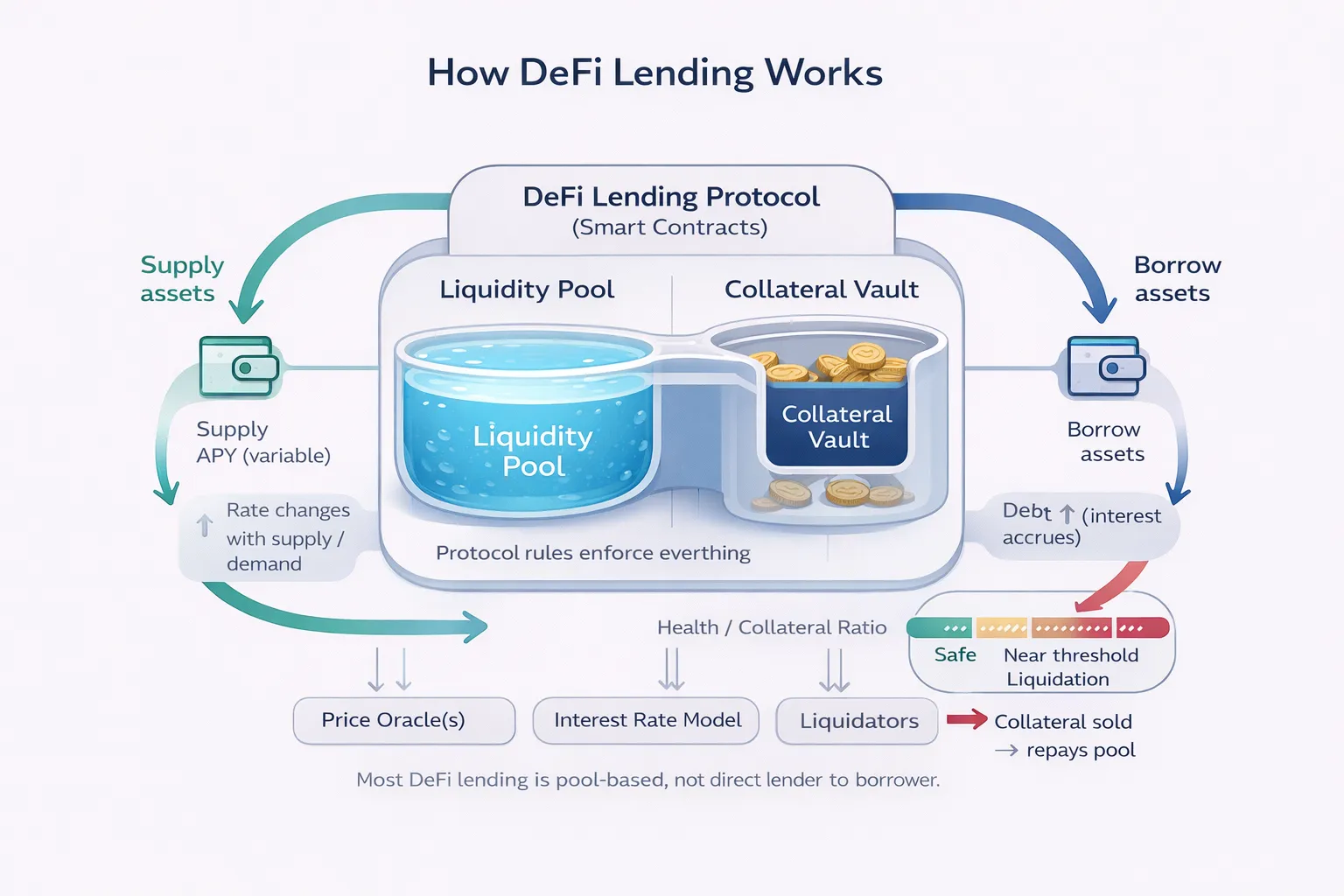
Most platforms offer a real-time LTV dashboard, but it often lags behind market volatility. Set up alerts for when your LTV approaches 80% of the liquidation threshold. This buffer gives you time to add collateral or repay debt before a forced sale occurs, which would severely damage your credit score.
Lenders assign different risk weights to different assets. Using only volatile altcoins can trigger a rapid credit score drop during a market downturn. Mix stablecoins with blue-chip assets like Bitcoin or Ethereum to stabilize your collateral value. This diversification reduces the risk of sudden devaluation that lenders penalize.
Not all protocols are equal. Some decentralized lending platforms have lower liquidity pools, meaning your collateral might be harder to liquidate or your loan harder to repay at a fair price. Check the protocol’s total value locked (TVL) and audit history. Higher liquidity protocols generally offer more stable credit scoring because they can handle market shocks without disrupting your account.
| Metric | Credit Score Impact | Recommended Action |
|---|---|---|
| LTV Ratio | High | Keep below 70% |
| Asset Volatility | Medium | Diversify with stablecoins |
| Protocol Liquidity | Low | Choose high TVL platforms |
Final checks before you borrow
Before locking up your assets, verify that the platform reports to major credit bureaus. If it does not, your borrowing activity will not help your score. Always read the fine print on how liquidations are reported. A single liquidation can drop your score by dozens of points, making future borrowing expensive or impossible.
Spotting Weak Collateral Claims
DeFi platforms often market "crypto credit scores" as if they are standardized, like a FICO score. In reality, these metrics are proprietary and rarely transparent. When you lock up assets to borrow, you are not building a universal credit history; you are securing a specific loan against volatile collateral.
Many platforms overstate the utility of their internal scores. They may claim your on-chain activity builds a "reputation," but most lenders do not share this data with traditional credit bureaus or even other DeFi protocols. This creates a siloed risk model where your good behavior on Protocol A does not help you on Protocol B.
Be wary of platforms that promise high loan-to-value (LTV) ratios without explaining their liquidation mechanisms. A high LTV might seem attractive, but it leaves little room for price swings. If the collateral drops just 10%, you could face immediate liquidation. Always check the liquidation threshold, not just the initial borrowing limit.
Also, watch for hidden fees in "credit score" upgrades. Some services charge for access to better rates or higher limits, but these fees rarely translate into actual financial benefits. The best collateral management is simple: low LTV, stable assets, and clear terms.
Crypto credit score 2026: what to check next
DeFi collateralization has shifted how creditworthiness is measured, creating a split between traditional financial reporting and on-chain reputation. Understanding where your activities appear—and where they don’t—is essential for managing your financial footprint in 2026.
Does crypto activity affect my traditional credit score?
Buying or trading cryptocurrency generally does not appear on your traditional credit history. Major credit bureaus do not track decentralized finance (DeFi) interactions or standard spot trades, meaning your crypto activity remains invisible to conventional lenders. However, if you take out a crypto-backed loan through a platform that reports to these bureaus, the loan’s status will be recorded. Missed payments on such loans can significantly damage your traditional credit score, while timely payments may offer a modest boost.
How does DeFi collateralization impact a crypto-native score?
In the DeFi ecosystem, your "credit score" is essentially your on-chain reputation. Lenders assess this by analyzing your wallet’s history: the types of assets you hold, the loan-to-value (LTV) ratios you maintain, and your repayment consistency. Unlike traditional scoring, which relies on income verification, DeFi scoring is purely behavioral. A wallet that consistently maintains healthy collateral buffers and repays loans on time builds a high reputation score, unlocking access to better terms and higher borrowing limits on platforms like Aave or Compound.
Can I use my DeFi history to get a traditional loan?
Currently, few traditional lenders accept DeFi on-chain data as proof of creditworthiness. While "crypto-native credit scores" are emerging to bridge this gap, they are not yet widely integrated into traditional mortgage or banking applications. Most DeFi activity remains siloed within blockchain ecosystems. If you plan to apply for a traditional mortgage soon, it is safer to assume your DeFi history will not help your application unless you have a specific lender who accepts alternative data sources.
What is the risk of liquidation for my crypto credit score?
Liquidations are the single biggest threat to your on-chain reputation. If the value of your collateral drops below the required threshold, the protocol will automatically liquidate your assets. This event is recorded permanently on the blockchain and can severely lower your wallet’s reputation score. A liquidated wallet may face higher interest rates or be restricted from borrowing new assets for an extended period, effectively isolating you from the most favorable lending terms in the DeFi landscape.
No comments yet. Be the first to share your thoughts!