

Decentralized finance has long relied on over-collateralization to secure loans, demanding borrowers lock up assets worth far more than the borrowed amount. This approach, while safeguarding lenders, stifles capital efficiency and excludes those without excess holdings. Enter on-chain risk scores, a transformative tool harnessing DeFi repayment history to enable under-collateralized DeFi lending. By analyzing transparent blockchain data, these scores assess borrower reliability, slashing collateral needs and unlocking broader access to credit.
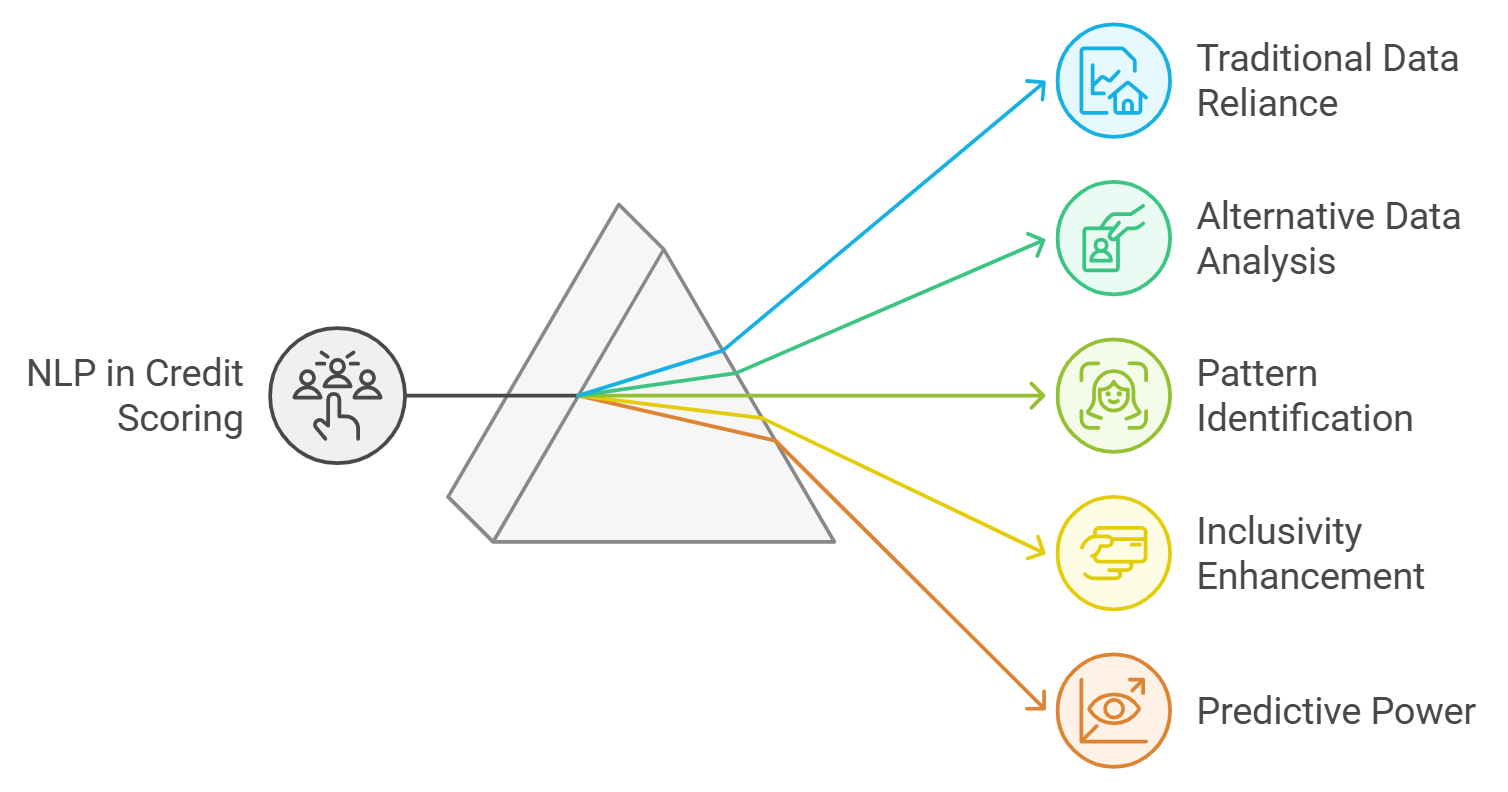
Traditional DeFi protocols like Aave and Compound enforce ratios often exceeding 150%, tying up billions in idle capital. Yet, as protocols mature, they recognize that not all risk demands such rigidity. On-chain metrics;repayment patterns, liquidation avoidance, and wallet activity;offer a verifiable proxy for creditworthiness. This shift promises higher yields for lenders willing to trust data over deposits.
Unpacking On-Chain Risk Scores
At their core, decentralized credit scoring systems aggregate on-chain behaviors into quantifiable scores. Platforms scrutinize transaction histories, loan repayments, and even cross-protocol interactions. For instance, consistent on-time repayments elevate scores, signaling low default probability. Predictive models layer in simulations of market stress, forecasting borrower resilience.
Consider Spectral's AI-driven approach: it processes behavioral data to automate approvals, sidestepping centralized checks. Similarly, Credora blends on-chain and off-chain signals for nuanced evaluations. These tools dynamically adjust loan-to-value ratios, allowing high-score borrowers to pledge just 50% collateral or less.
Pioneering On-Chain Credit Protocols
- Morpho (custom markets): Decentralized lending network with Morpho V2 enabling institutional-scale on-chain credit assessments to reduce collateral needs.

- Spectral (AI analysis): Uses AI models to analyze on-chain behavioral data for automated loan approvals in undercollateralized DeFi.

- Credora (hybrid signals): Provides credit scores combining on-chain and off-chain data for DeFi lending protocols.

- TrueFi (reputation-based): Executes undercollateralized lending with on-chain reputation and repayment enforcement.

- Goldfinch (on-chain repayments): Focuses on undercollateralized loans backed by verifiable on-chain repayment history.

Morpho's Blueprint for Institutional Lending
Morpho, launched in 2021, exemplifies this evolution with its V2 upgrade in June 2025. This version crafts tailored lending markets, integrating onchain reputation lending to minimize collateral. Lenders set parameters based on risk scores, fostering institutional-grade pools without intermediaries. The result? Capital utilization soars, as funds circulate rather than stagnate.
Morpho's decentralized network proves that crypto undercollateralized loans can scale securely, blending peer-to-peer flexibility with robust risk controls.
Aave complements this through adaptive interest rates, responding to real-time conditions via on-chain data. Dynamic controllers mitigate liquidation cascades, rewarding reliable borrowers with favorable terms. Such innovations address DeFi's capital inefficiency, where over-collateralization historically locked 70-80% of value idly.
Real-World Protocols Driving Adoption
TrueFi and Goldfinch have executed substantial under-collateralized DeFi lending volumes on-chain, relying on vetted repayment histories. TrueFi's credit delegation model lets trusted parties underwrite loans, backed by community governance. Goldfinch extends this to emerging markets, using on-chain proof-of-repayments for junior tranches that absorb first losses.
These protocols highlight a key insight: on-chain transparency breeds trust. Unlike opaque TradFi scores, anyone verifies a borrower's track record via explorers. This verifiability curbs moral hazard, as repeat defaulters face ecosystem-wide exclusion. Yet, precision matters; scores must balance historical data with forward-looking volatility gauges to avert correlated defaults in bear markets.
Building these scores demands more than raw data aggregation; it requires sophisticated oracles and AI to filter noise from signal. Platforms like Spectral deploy machine learning models that parse wallet interactions, flagging patterns like frequent liquidations or erratic borrowing as red flags. High performers, conversely, unlock crypto undercollateralized loans with loan-to-value ratios dipping below 100%, freeing capital for productive use across DeFi ecosystems.
Navigating Risks in Under-Collateralized Models
While promising, under-collateralized DeFi lending exposes lenders to amplified defaults without excess assets as backstops. Borrowers might vanish post-disbursal, especially in volatile markets where asset prices swing wildly. Smart contract flaws compound this; a single exploit could drain pools, as history with Ronin or Poly Network reminds us. Privacy looms large too, with public ledgers laying bare financial trails that savvy actors could weaponize.
Key Challenges in On-Chain Risk Scoring and Mitigations
| Challenge | Description | Mitigation |
|---|---|---|
| Default Risk | Elevated default risk without over-collateralization, as borrowers may not repay loans | Diversified lending pools and on-chain credit scores leveraging repayment history (e.g., Spectral, Morpho) |
| Smart Contract Vulnerabilities | Reliance on complex smart contracts increases attack surface and susceptibility to exploits | Comprehensive audits and formal verification |
| Creditworthiness Assessment Gaps | Lack of standardized frameworks for evaluating borrower reliability compared to traditional finance | Hybrid data integrating on-chain activity with off-chain sources (e.g., DECO) |
| Privacy Concerns | Public blockchain transparency exposes users' financial habits and personal information | Zero-knowledge proofs for privacy-preserving data verification |
Yet these hurdles are surmountable. Diversified lender pools spread default exposure, much like junior-senior tranches in Goldfinch. Rigorous audits and formal verification, as Morpho employs, fortify contracts against exploits. For credit gaps, hybrid models blending on-chain with zero-knowledge verified off-chain data bridge reliability without compromising decentralization. Privacy tech like zk-SNARKs lets users prove repayment history sans revealing full addresses, preserving pseudonymity.
In my experience evaluating DeFi portfolios, the crux lies in dynamic adjustments. Scores should evolve with market regimes, tightening collateral in downturns while loosening in bulls. Aave's adaptive rates exemplify this, using oracles to modulate based on volatility indices. Such precision not only curbs losses but incentivizes good behavior, as borrowers chase score improvements for better terms.
Ethereum Technical Analysis Chart
Analysis by Market Analyst | Symbol: BINANCE:ETHUSDT | Interval: 1D | Drawings: 6
Technical Analysis Summary
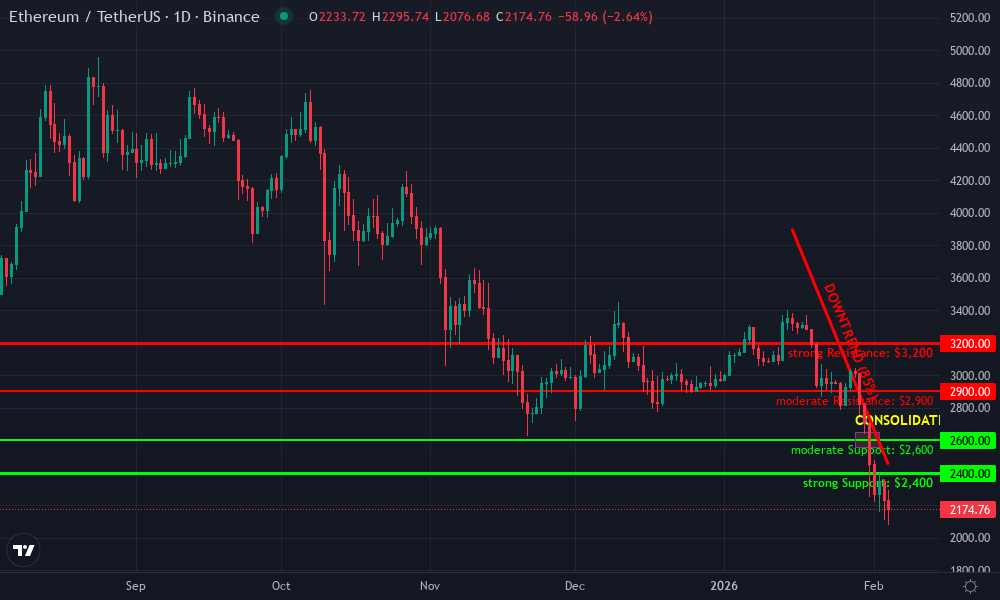
To annotate this ETHUSDT chart effectively in my balanced technical style, start by drawing a prominent downtrend line connecting the swing high at approximately 2026-01-15 around $3,900 to the recent low near 2026-02-04 at $2,450, using the 'trend_line' tool with a dashed red line for bearish emphasis. Add horizontal support at $2,400 (strong, recent lows) and $2,600 (moderate, prior bounces) with green lines, and resistance at $2,900 (moderate) and $3,200 (strong, prior breakdown). Mark a consolidation rectangle from 2026-01-28 to 2026-02-02 between $2,550-$2,650. Use fib_retracement from the peak to recent low for potential retracement levels (38.2% at ~$2,950). Place arrow_mark_down at the MACD bearish crossover around 2026-01-25, and callout on declining volume. Add long_position entry zone at $2,450 with stop_loss below $2,400 and profit_target at $2,900. Vertical_line for potential news event impact on 2026-02-04 dip. Text labels for key insights like 'DeFi risk weighing on ETH'. This setup highlights bearish momentum with bounce potential aligned to medium risk tolerance.
Risk Assessment: medium
Analysis: Bearish trend intact but oversold with declining volume; DeFi undercollateralized lending risks add fundamental downside, balanced by potential rebound on positive on-chain developments
Market Analyst's Recommendation: Consider low conviction longs from $2,450 support with tight stops; wait for $2,600 break for higher conviction. Scale in per medium risk tolerance.
Key Support & Resistance Levels
📈 Support Levels:
- $2,400 - Strong support at recent multi-candle lows, aligning with 61.8% fib retracement strong
- $2,600 - Moderate support from early February bounces moderate
📉 Resistance Levels:
- $2,900 - Moderate resistance from prior consolidation breakdown moderate
- $3,200 - Strong resistance at 50% fib retracement and prior swing low strong
Trading Zones (medium risk tolerance)
🎯 Entry Zones:
- $2,450 - Bounce from strong support with volume spike potential amid DeFi news digestion medium risk
- $2,600 - Breakout above minor resistance for continuation play low risk
🚪 Exit Zones:
- $2,900 - Initial profit target at moderate resistance 💰 profit target
- $2,900 - Trailing stop or fib extension 💰 profit target
- $2,350 - Invalidation below key support 🛡️ stop loss
Technical Indicators Analysis
📊 Volume Analysis:
Pattern: declining on downmove
Volume decreasing during descent indicates weakening seller conviction, potential exhaustion
📈 MACD Analysis:
Signal: bearish crossover with divergence
MACD line crossed below signal in late January, but histogram contracting suggests fading momentum
Applied TradingView Drawing Utilities
This chart analysis utilizes the following professional drawing tools:
Disclaimer: This technical analysis by Market Analyst is for educational purposes only and should not be considered as financial advice. Trading involves risk, and you should always do your own research before making investment decisions. Past performance does not guarantee future results. The analysis reflects the author's personal methodology and risk tolerance (medium).
Pathways to Mainstream Adoption
Protocols like TrueFi pioneer credit delegation, where senior lenders back juniors vetted by on-chain reps. This layers risk intelligently, echoing TradFi syndication but transparently. Mitosis and Credora push further, fusing predictive analytics with historical DeFi repayment history for OCCR-style scores that forecast defaults under stress scenarios. Imagine lenders offering 80% LTV to a wallet with 99% repayment rate over 50 loans; that's the efficiency on-chain data unlocks.
Regulatory tailwinds aid this too. As institutions eye DeFi, frameworks valuing on-chain proof over black-box models gain traction. Morpho V2's institutional markets, live since mid-2025, already host billions in TVL, proving scalability. Lenders report 20-30% yield uplifts versus rigid collateral pools, per recent analyses.

Still, success hinges on standardization. Interoperable scores across chains via bridges or Layer 2s would amplify utility, letting a Polygon borrower's rep secure Ethereum loans. Developers at cryptocreditscore. org advocate this, building DID-integrated tools for seamless on-chain risk scores that plug into any protocol.
Ultimately, decentralized credit scoring redefines DeFi's promise: credit as a function of behavior, not just balance sheets. Lenders gain efficiency, borrowers access without overkill pledges, and the ecosystem thrives on verifiable trust. As adoption swells, expect under-collateralized volumes to eclipse overcollateralized relics, heralding a more equitable crypto finance landscape.




No comments yet. Be the first to share your thoughts!